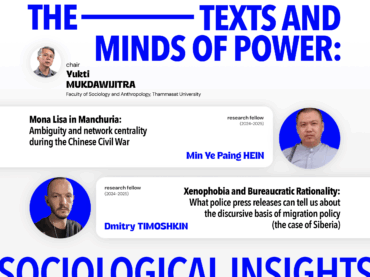
This workshop is part of the Faculty of Sociology and Anthropology research fellow programme, in collaboration with the MA (Anthropology) course, AN603 Review of Research Topics in Anthropology
contact
- Rapeephan CHAROENWONG
- email: ccscs.tu@gmail.com
programme
9.30 | registration
9.50 – 10.00 | opening remarks
- asst. prof. Chantanee CHAROENSRI, PhD
Dean, Faculty of Sociology and Anthropology
10.00 – 13.00 | Exploring the Texts and Minds of Power: Sociological insights from official state documents
- Mona Lisa in Manchuria: Ambiguity and network centrality during the Chinese Civil War
Min Ye Paing HEIN, PhD
research fellow (2024-2025) -
Xenophobia and Bureaucratic Rationality: What police Press releases can tell us about the discursive basis of migration policy (the case of Siberia)
Dmitry TIMOSHKIN, PhD
research fellow (2024-2025) - chair
assoc. prof. Yukti MUKDAWIJITRA, PhD
Faculty of Sociology and Anthropology
abstracts
Mona Lisa in Manchuria: Ambiguity and network centrality during the Chinese Civil War
Min Ye Paing HEIN, PhD
In 1930, on the eve of China’s Central Plains War, Marshal Zhang Xueliang issued a cryptically cordial circular telegram urging peace between rival factions. Laced with ambiguity, the message triggered competing interpretations and confusion across the political spectrum—particularly within the Nanjing government—making it a classic instance of robust action.
This paper uses Zhang’s March 1st telegram to extend Padgett and Ansell’s (1993) theory of robust action. While existing accounts focus on actors’ structurally privileged positions in multiplex networks, I argue that robustness also depends on network strategies: the active cultivation, calibration, and management of ties amid deep uncertainty.
Zhang’s ability to sustain multiple meanings for multiple audiences was not a product of structural luck, but of strategic effort—managing rival networks, manipulating expectations, and embedding ambiguity within carefully maintained relationships. His case demonstrates that robust action is not merely structural but fundamentally strategic.
Xenophobia and Bureaucratic Rationality: What police Press releases can tell us about the discursive basis of migration policy (the case of Siberia)
Dmitry TIMOSHKIN, PhD
This presentation investigates how texts produced by regional state authorities in Russia construct migration-related discourse. These texts are approached through a “soft” constructionist lens, interpreting them as tools for problematizing social processes and for producing and sustaining a discourse of power.
The study combines quantitative content analysis and discourse analysis to identify “chains of equivalence” that imbue the nodal signifier “migration” with meaning in official texts. It focuses on the social contexts assigned to migrants, the spaces they are said to occupy, and the actions in which they are involved—as both subjects and objects.
The study posits that in Russia’s regions, the official migration narrative is primarily shaped by the Ministry of Internal Affairs (MVD) and municipal authorities. Both adopt a strategy of problematizing migration, portraying migrants as a problematic group. This framing has two dominant dimensions: first, migrants are seen as disruptors of the established moral order (“traditional values”); second, they are constructed as a potential source of violence (e.g., crime, terrorism, extremism).
In MVD discourse, migrants are portrayed simultaneously as a threat and a resource—as an economic foundation for an extractive logic. Practices such as raids function both as tools for revenue generation and as mechanisms to boost performance metrics. The use of violence as a primary extractive method is justified through the portrayal of migrants as inherently suspicious, posing risks to both “operational stability” and “traditional values.” Coercive actions are framed as effective and necessary; prosecuting “illegal” migrants is presented as the optimal solution to the problem of illegal migration. Even low crime rates among migrants are framed as a direct result of MVD intervention.
Civilian agencies present an alternative narrative, suggesting that migrants—perceived as “foreign” and marked by collective national identities—be granted space to express their difference in exchange for demonstrated loyalty to local authorities. However, even this ostensibly more tolerant framing still positions migrants as potential threats and objects of suspicion.
The recurrence of suspicion in these official texts reinforces public anxiety around migration, legitimizing forceful interventions as appropriate responses. This discursive pattern securitizes migration, linking it to unpredictability and latent violence. Additionally, the association between migrants and crime in press releases may be driven by the logic of clickbait: press departments are incentivized to highlight crime in order to amplify the reach of texts that showcase institutional efficacy.
The result is a self-reinforcing cycle: public fear, shaped by official narratives, increases demand for content that ties migration to crime. Civilian agencies, too, draw on this frame—albeit in different registers—using tools such as cultural events and NGO partnerships to promote alternative scripts of engagement, even while sustaining the underlying premise of migrants as a problem to be managed.