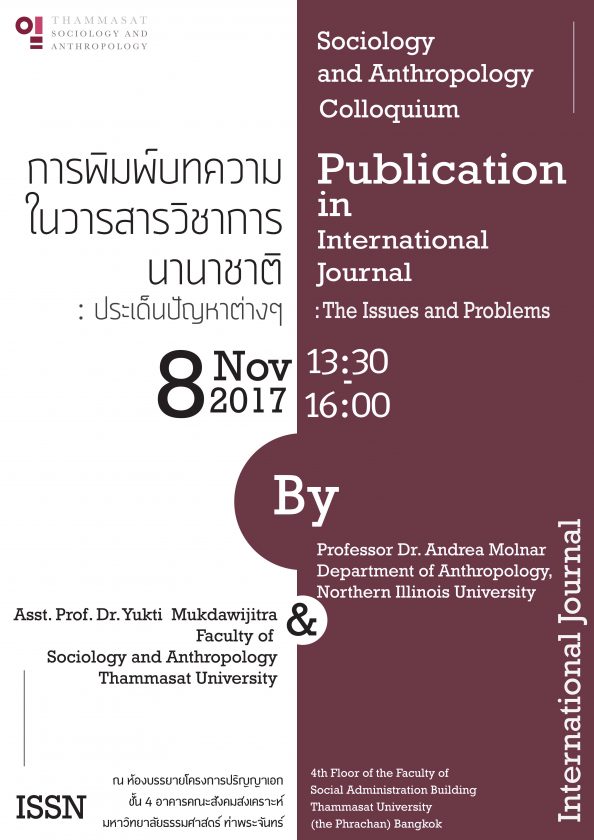
Faculty of Sociology and Anthropology, Thammasat University, would like to invite audience for seminar on Publication in International Journal: the Issues and Problems

Source: http://socanth.tu.ac.th/news/publication-international-journal/
by Professor Dr. Andrea Molnar
Department of Anthropology, Northern Illinois University

Wednesday 8 November 2017, 1.30 – 4.00 pm
at Doctorate Program Meeting Room, 4th Floor,
Faculty of Social Administration Building, Thammasat University, Tha Prachan Campus

Public Lecture on “Science and Technology Studies Across the Region”

Source: http://socanth.tu.ac.th/news/science-and-technology-studies_18_01_17/

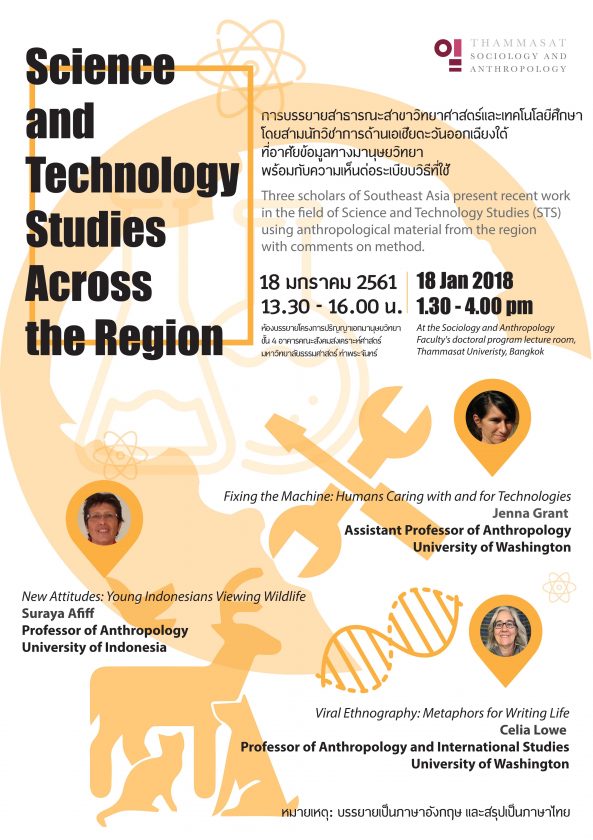
Research and Academic Service Section, Faculty of Sociology and Anthropology, would like to invite audience for public lecture from three anthropologists on Southeast Asia.

“Science and Technology Studies across the Region”
Thursday 18 January 2018, 1.30 – 4.00 pm
at Doctorate Program Meeting Room, 4th Floor, Faculty of Social Administration Building, Thammasat University, Tha Prachan Campus

Programme

1.30 – 4.00 pm
Fixing the Machine : Humans Caring with and for Technologies
Jenna Grant
Assistant Professor of Anthropology
University of Washington

New Attitudes: Young Indonesians Viewing Wildlife
Suraya Afiff
Professor of Anthropology
University of Indonesia

Viral Ethnography: Metaphors for Writing Life
Celia Lowe
Professor of Anthropology and International Studies
University of Washington

The 1st Social Sciences and Humanities Dialogues

Source: http://socanth.tu.ac.th/news/academic-events-updates/social-sciences-and-humanities-dialogues-1/

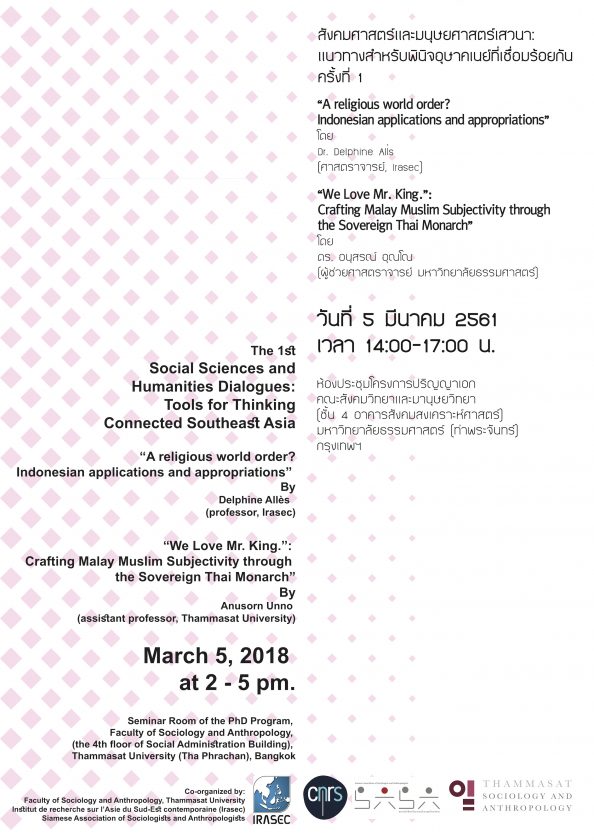
Faculty of Sociology and Anthropology in collaboration with Institut de recherche sur l’Asie du Sud-Est contemporaine (Irasec) and Siamese Association of Sociologists and Anthropologists (SASA) would like to invite audience to join a seminar of the 1st Social Sciences and Humanities Dialogues: Guidelines for Looking at Connected Southeast Asia (1st).

Monday, 5 March 2018 | 2-5pm
PhD meeting room, Faculty of Sociology and Anthropology,
4th floor, Faculty of Social Administration Building,
Thammasat University, Tha Prachan
Programme

1.30 pm | registration

2.00 – 3.00 pm
A Religious World order? Indonesian applications and appropriations
Professor Delphine Allès
University of Paris East (Créteil) / Irasec
Author of Transnational Islamic Actors and Indonesia’s Foreign Policy
(Routledge 2015)

Secularism, long (and wrongly) considered a feature of modern international relations, has fallen into disuse. It has become outmoded not to take “religion” or “religious actors” into account in the formulation or implementation of international public policies, which increasingly aim at “integrating” or “involving” religious actors. In addition to conventional religious diplomacies, a growing number of initiatives aim to foster “intercivilizational dialogue” or “interfaith dialogue”. New interstate alliances based on religious criteria have emerged. And religious interpretations of human rights are legion. These evolutions, however, refer to a restrictive conception of “religion”, subject to a political filter that addresses religious categories as homogeneous, effectively representative of the adherents they claim, and necessarily distinct from the secular sphere. By selecting actors to represent much broader communities, by offering resources to religious entrepreneurs who succeed in streamlining their own agendas with the expectations of states and international organizations, or even by creating dynamics of rejection, these initiatives tend to transform the social and religious contexts in which they are deployed. It is the case in Indonesia, where one can observe the conjunction between the narratives conveyed by the main actors on the international scene, the official definition of “religion”, and initiatives implemented by co-opted religious organizations. Meanwhile, new religious movements emerge that are characterized by the assertion of their autonomy from politics and institutionalized religions. This presentation analyses the religious dimensions of contemporary world politics, to explore the ways in which official religious categories have transformed local religious representations and practices, while being transformed in return by their local appropriations.

3.15 – 4.15 pm
“We love Mr.King”: Crafting Malay Muslim Subjectivity through the Sovereign Thai Monarch
Dr. Anusorn Unno
Faculty of Sociology and Anthropology, Thammasat University

The talk is about how Malay Muslims of southern Thailand dealt with a question of subjectivity in relation to sovereignty in the wake of the recent unrest. It focuses on how they crafted their subjectivity through the sentence “เรารักนายหลวง” (Rao Rak Nay Luang, or We love Mr. King) inscribed with cooked sticky rice on a ceremonial platter they made for the participation in a state ceremony. Drawing on anthropological discussion of subjectivity and agency in relation to sovereignty, it argued that, as the Thai state in a “state of exception,” the Thai monarch is a sovereign through whom Malay Muslims can craft their subjectivity and enact their agency when engaging with state authorities. It also argues that being put into an exceptional state via the title “นายหลวง” (Nay Luang or Mr. King), the king is rendered human, enabling Malay Muslims to have an intimate relationship with him without compromising their religious principles.

However, while enabling Malay Muslims to engage state authorities with authority, to craft subjectivity and to enact agency through the monarch in a state of exception this way is self-contradictory, as the subjectivity was crafted by stripping the king of his god-like features, whilst agency was enacted by treating the king as sovereign. Moreover, the central feature of the king’s sovereignty, which resides in his ability to suspend the application of law, implies privilege, whereas what Malay Muslims have been demanding is equality and justice. Rather than the exceptional king in an exceptional state, it should be the Thai state with fragmented and flexible sovereignty that is a means through which Malay Muslims of Southern Thailand can realize their ethno-religious concerns and political aspirations.

4.15 pm
Discussion
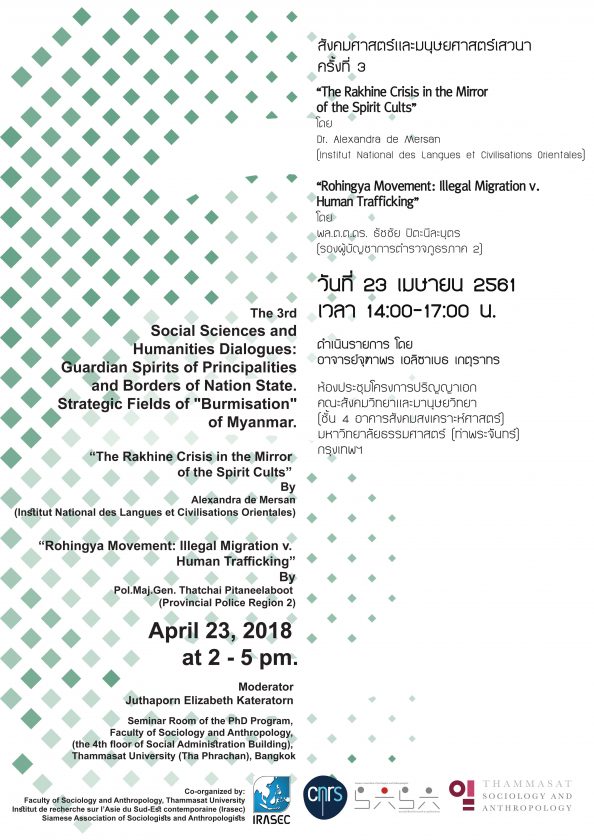
The 3rd Social Sciences and Humanities Dialogues

Source: http://socanth.tu.ac.th/news/academic-events-updates/social-sciences-and-humanities-dialogues-3/

Faculty of Sociology and Anthropology in collaboration with Institut de recherche sur l’Asie du Sud-Est contemporaine (Irasec) and Siamese Association of Sociologists and Anthropologists (SASA) would like to invite audience to join a seminar of

The 3rd Social Sciences and Humanities Dialogues
Guardian Spirits of Principalities and Borders of Nation State,
Strategic Fields of “Burmisation” of Myanmar

Monday, 23 April 2018 | 2-5pm
PhD meeting room, Faculty of Sociology and Anthropology,
4th floor, Faculty of Social Administration Building,
Thammasat University, Tha Prachan

Programme

1.30 pm | registration

2.00 – 3.30 pm
The Rakhine Crisis in the Mirror of the Spirit Cults
Dr. Alexandra de Mersan
Institut National des Langues et Civilisations Orientales

3.30 – 5.00 pm
Rohingya Movement: Illegal Migration v. Human Trafficking
Pol.Maj.Gen. Tatchai Pitaneelabutr,
Deputy Commissioner of Provincial Police Region 2

Hosted by Arjan. Juthaporn Elizabeth Kateratorn

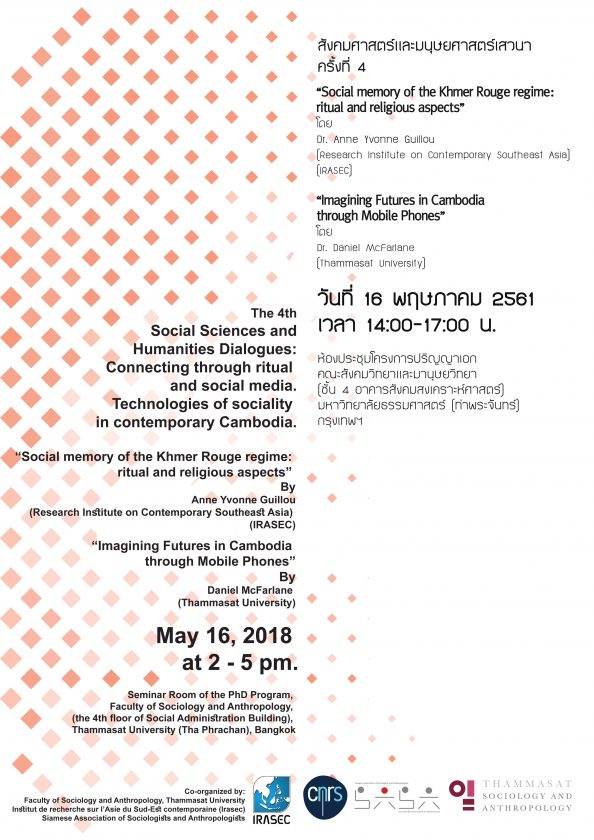
The 4th Social Sciences and Humanities Dialogues

Source: http://socanth.tu.ac.th/news/academic-events-updates/https-socanth-tu-ac-th-news-academic-events-updates-social-sciences-and-humanities-dialogues-4/

Faculty of Sociology and Anthropology in collaboration with Institut de recherche sur l’Asie du Sud-Est contemporaine (Irasec) and Siamese Association of Sociologists and Anthropologists (SASA) would like to invite audience to join a seminar of

The 4th Social Sciences and Humanities Dialogues:
Connecting through ritual and social media.
Technologies of sociality in contemporary Cambodia.

Wednesday, 16 May 2018 | 2-5 pm.
PhD meeting room, Faculty of Sociology and Anthropology,
4th floor, Faculty of Social Administration Building,
Thammasat University, Tha Prachan

Programme

1.30 pm | registration

2.00 – 5.00 pm
“Social Memory of the Khmer Rouge Regime: Ritual and Religious Aspects”

Anne Yvonne Guillou
(Research Institute on Contemporary Southeast Asia) (IRASEC)

Abstract

Social memory has been studied for decades by social scientists and can be broadly defined as social constructions of past events collectively experienced and remembered (or alternatively forgotten) by social groups. It has been analyzed primarily by anthropologists in reference to local perceptions of time and space (M. Bloch, A. Gell, A. Iteanu). Other researches in sociology, anthropology and political science have studied its social background (M. Halbwachs, Maurice Bloch, M. Auge), its cognitive dimensions (J. Candau), the political and social stakes of official commemorations (P. Nora, P. Connerton, J. Gillis), the embodiement of past events (D. Fassin) and the transmission of painful memory (D. Graeber, P.Antze et M. Lambek). Using this theoretical literature, Anne Guillou’s research on social memory of the Khmer Rouge regime in Cambodia is also based on ten years of ethnographic field work mainly in Western Cambodia. She has forged a specific methodology over time in order to better understand how the Khmer villagers collectively remember the times of the genocidal regime and copy with losses and painful remembrance. She comes to the conclusion that this memory is anchored in the Khmer religious system in which cults linked to the earth and the dead are crucial components.

And “Imagining Futures in Cambodia through Mobile Phones”
Daniel McFarlane (Thammasat University)

McFarlane’s talk will reflect on how futures are imagined, calculated and enacted through communication technologies and corporate marketing in Cambodia. His talk draws on ethnographic research he conducted in a period of rapid change in Cambodia. Mobile phone subscription rates were growing at nearly 50% per year, and nine mobile phone network operators dominated an emerging consumer market. At the forefront of the change were transnational corporations and Cambodian youth. McFarlane explores how the marketers of mobile network services in Cambodia constructed the youth as consumers and how young Cambodians turned mobile phones and networks into an infrastructure for imagining and exploring the future. From this vantage point, he constructs a critique of the representation of new mobile technologies as a reconciliation between neoliberal capitalism and the global poor by detailing the collisions and disjunctures between the imaginings of corporate marketers and Cambodian youth.