Field Devices: Creative intervention and the materialities of ethnographic encounter

[siteorigin_widget class=”SiteOrigin_Widget_Image_Widget”][/siteorigin_widget]

This workshop is part of the Faculty of Sociology and Anthropology research cluster, Digital Media and Culture in Southeast Asia, in collaboration with the MA (Anthropology) course, AN603 Review of Research Topics in Anthropology


contact

  • Rapeephan Charoenwong
  • email: ccscs.tu@gmail.com

Friday, 15 August 2025 | 10.00-13.00 hrs.

Faculty of Sociology and Anthropology meeting room,
Fl.4, Faculty of Social Administration Building, Thammasat University, Tha Prachan


programme

9.30 | registration

10.00 – 10.10 | opening remarks

  • Yukti Mukdawijitra
    convenor, AN603 Review of Research Topics in Anthropology
    Faculty of Sociology and Anthropology, Thammasat University

10.00 – 13.00 | Field Devices: Creative intervention and the materialities of ethnographic encounter


recommended readings 

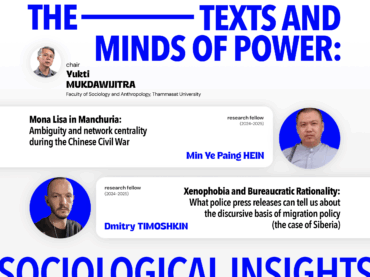
Exploring the Texts and Minds of Power: Sociological insights from official state documents

[siteorigin_widget class=”SiteOrigin_Widget_Image_Widget”][/siteorigin_widget]

This workshop is part of the Faculty of Sociology and Anthropology research fellow programme, in collaboration with the MA (Anthropology) course, AN603 Review of Research Topics in Anthropology

contact

  • Rapeephan CHAROENWONG
  • email: ccscs.tu@gmail.com

programme

9.30 | registration

9.50 – 10.00 | opening remarks

  • asst. prof. Chantanee CHAROENSRI, PhD
    Dean, Faculty of Sociology and Anthropology

10.00 – 13.00 | Exploring the Texts and Minds of Power: Sociological insights from official state documents

  • Mona Lisa in Manchuria: Ambiguity and network centrality during the Chinese Civil War
    Min Ye Paing HEIN, PhD
    research fellow (2024-2025)
  • Xenophobia and Bureaucratic Rationality: What police Press releases can tell us about the discursive basis of migration policy (the case of Siberia)
    Dmitry TIMOSHKIN, PhD
    research fellow (2024-2025)

  • chair
    assoc. prof. Yukti MUKDAWIJITRA, PhD 
    Faculty of Sociology and Anthropology

abstracts

Mona Lisa in Manchuria: Ambiguity and network centrality during the Chinese Civil War
Min Ye Paing HEIN, PhD

In 1930, on the eve of China’s Central Plains War, Marshal Zhang Xueliang issued a cryptically cordial circular telegram urging peace between rival factions. Laced with ambiguity, the message triggered competing interpretations and confusion across the political spectrum—particularly within the Nanjing government—making it a classic instance of robust action.

This paper uses Zhang’s March 1st telegram to extend Padgett and Ansell’s (1993) theory of robust action. While existing accounts focus on actors’ structurally privileged positions in multiplex networks, I argue that robustness also depends on network strategies: the active cultivation, calibration, and management of ties amid deep uncertainty.

Zhang’s ability to sustain multiple meanings for multiple audiences was not a product of structural luck, but of strategic effort—managing rival networks, manipulating expectations, and embedding ambiguity within carefully maintained relationships. His case demonstrates that robust action is not merely structural but fundamentally strategic.


Xenophobia and Bureaucratic Rationality: What police Press releases can tell us about the discursive basis of migration policy (the case of Siberia)
Dmitry TIMOSHKIN, PhD

This presentation investigates how texts produced by regional state authorities in Russia construct migration-related discourse. These texts are approached through a “soft” constructionist lens, interpreting them as tools for problematizing social processes and for producing and sustaining a discourse of power.

The study combines quantitative content analysis and discourse analysis to identify “chains of equivalence” that imbue the nodal signifier “migration” with meaning in official texts. It focuses on the social contexts assigned to migrants, the spaces they are said to occupy, and the actions in which they are involved—as both subjects and objects.

The study posits that in Russia’s regions, the official migration narrative is primarily shaped by the Ministry of Internal Affairs (MVD) and municipal authorities. Both adopt a strategy of problematizing migration, portraying migrants as a problematic group. This framing has two dominant dimensions: first, migrants are seen as disruptors of the established moral order (“traditional values”); second, they are constructed as a potential source of violence (e.g., crime, terrorism, extremism).

In MVD discourse, migrants are portrayed simultaneously as a threat and a resource—as an economic foundation for an extractive logic. Practices such as raids function both as tools for revenue generation and as mechanisms to boost performance metrics. The use of violence as a primary extractive method is justified through the portrayal of migrants as inherently suspicious, posing risks to both “operational stability” and “traditional values.” Coercive actions are framed as effective and necessary; prosecuting “illegal” migrants is presented as the optimal solution to the problem of illegal migration. Even low crime rates among migrants are framed as a direct result of MVD intervention.

Civilian agencies present an alternative narrative, suggesting that migrants—perceived as “foreign” and marked by collective national identities—be granted space to express their difference in exchange for demonstrated loyalty to local authorities. However, even this ostensibly more tolerant framing still positions migrants as potential threats and objects of suspicion.

The recurrence of suspicion in these official texts reinforces public anxiety around migration, legitimizing forceful interventions as appropriate responses. This discursive pattern securitizes migration, linking it to unpredictability and latent violence. Additionally, the association between migrants and crime in press releases may be driven by the logic of clickbait: press departments are incentivized to highlight crime in order to amplify the reach of texts that showcase institutional efficacy.

The result is a self-reinforcing cycle: public fear, shaped by official narratives, increases demand for content that ties migration to crime. Civilian agencies, too, draw on this frame—albeit in different registers—using tools such as cultural events and NGO partnerships to promote alternative scripts of engagement, even while sustaining the underlying premise of migrants as a problem to be managed.

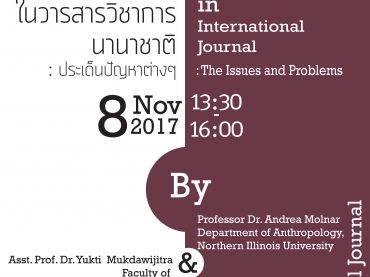
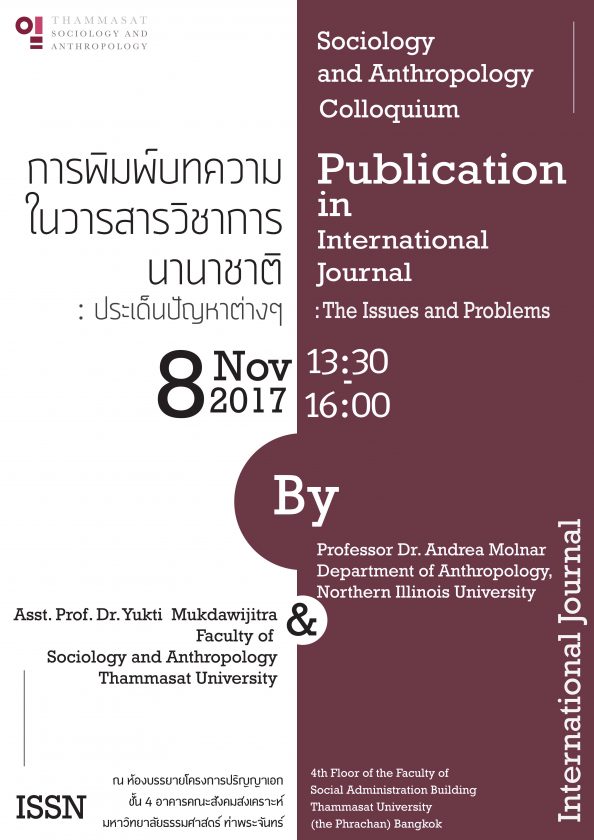
Faculty of Sociology and Anthropology, Thammasat University, would like to invite audience for seminar on Publication in International Journal: the Issues and Problems

Source: http://socanth.tu.ac.th/news/publication-international-journal/
by Professor Dr. Andrea Molnar
Department of Anthropology, Northern Illinois University

Wednesday 8 November 2017, 1.30 – 4.00 pm
at Doctorate Program Meeting Room, 4th Floor,
Faculty of Social Administration Building, Thammasat University, Tha Prachan Campus

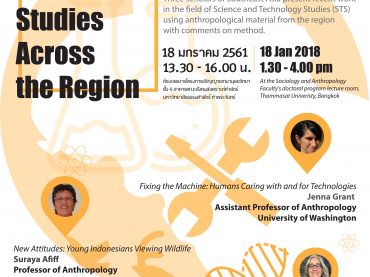
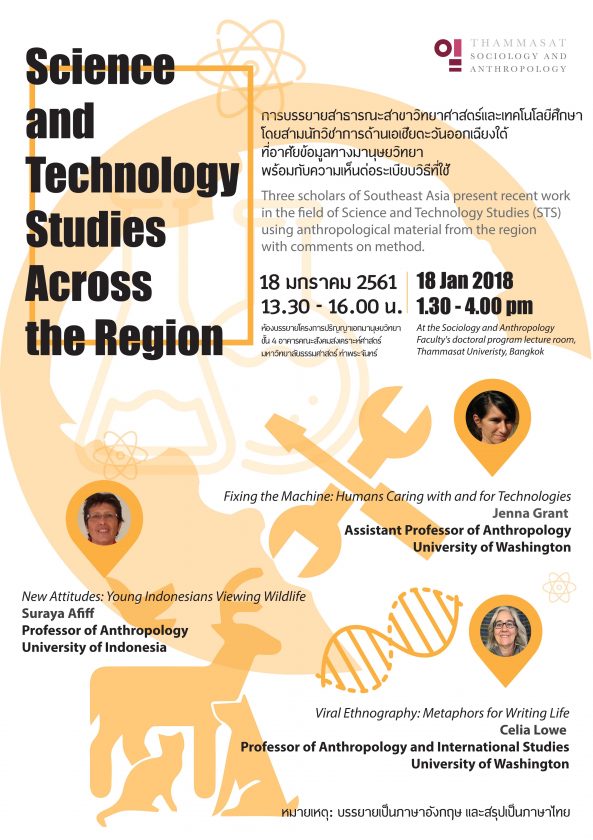
Public Lecture on “Science and Technology Studies Across the Region”

Source: http://socanth.tu.ac.th/news/science-and-technology-studies_18_01_17/

Research and Academic Service Section, Faculty of Sociology and Anthropology, would like to invite audience for public lecture from three anthropologists on Southeast Asia.

“Science and Technology Studies across the Region”
Thursday 18 January 2018, 1.30 – 4.00 pm
at Doctorate Program Meeting Room, 4th Floor, Faculty of Social Administration Building, Thammasat University, Tha Prachan Campus

Programme

1.30 – 4.00 pm
Fixing the Machine : Humans Caring with and for Technologies
Jenna Grant
Assistant Professor of Anthropology
University of Washington

New Attitudes: Young Indonesians Viewing Wildlife
Suraya Afiff
Professor of Anthropology
University of Indonesia

Viral Ethnography: Metaphors for Writing Life
Celia Lowe
Professor of Anthropology and International Studies
University of Washington

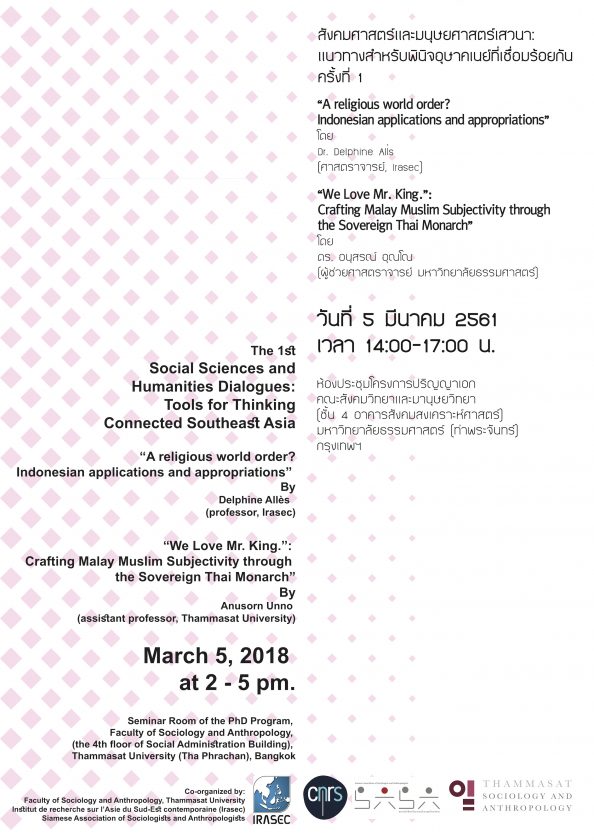
The 1st Social Sciences and Humanities Dialogues

Source: http://socanth.tu.ac.th/news/academic-events-updates/social-sciences-and-humanities-dialogues-1/

Faculty of Sociology and Anthropology in collaboration with Institut de recherche sur l’Asie du Sud-Est contemporaine (Irasec) and Siamese Association of Sociologists and Anthropologists (SASA) would like to invite audience to join a seminar of the 1st Social Sciences and Humanities Dialogues: Guidelines for Looking at Connected Southeast Asia (1st).

Monday, 5 March 2018 | 2-5pm
PhD meeting room, Faculty of Sociology and Anthropology,
4th floor, Faculty of Social Administration Building,
Thammasat University, Tha Prachan
Programme

1.30 pm | registration

2.00 – 3.00 pm
A Religious World order? Indonesian applications and appropriations
Professor Delphine Allès
University of Paris East (Créteil) / Irasec
Author of Transnational Islamic Actors and Indonesia’s Foreign Policy
(Routledge 2015)

Secularism, long (and wrongly) considered a feature of modern international relations, has fallen into disuse. It has become outmoded not to take “religion” or “religious actors” into account in the formulation or implementation of international public policies, which increasingly aim at “integrating” or “involving” religious actors. In addition to conventional religious diplomacies, a growing number of initiatives aim to foster “intercivilizational dialogue” or “interfaith dialogue”. New interstate alliances based on religious criteria have emerged. And religious interpretations of human rights are legion. These evolutions, however, refer to a restrictive conception of “religion”, subject to a political filter that addresses religious categories as homogeneous, effectively representative of the adherents they claim, and necessarily distinct from the secular sphere. By selecting actors to represent much broader communities, by offering resources to religious entrepreneurs who succeed in streamlining their own agendas with the expectations of states and international organizations, or even by creating dynamics of rejection, these initiatives tend to transform the social and religious contexts in which they are deployed. It is the case in Indonesia, where one can observe the conjunction between the narratives conveyed by the main actors on the international scene, the official definition of “religion”, and initiatives implemented by co-opted religious organizations. Meanwhile, new religious movements emerge that are characterized by the assertion of their autonomy from politics and institutionalized religions. This presentation analyses the religious dimensions of contemporary world politics, to explore the ways in which official religious categories have transformed local religious representations and practices, while being transformed in return by their local appropriations.

3.15 – 4.15 pm
“We love Mr.King”: Crafting Malay Muslim Subjectivity through the Sovereign Thai Monarch
Dr. Anusorn Unno
Faculty of Sociology and Anthropology, Thammasat University

The talk is about how Malay Muslims of southern Thailand dealt with a question of subjectivity in relation to sovereignty in the wake of the recent unrest. It focuses on how they crafted their subjectivity through the sentence “เรารักนายหลวง” (Rao Rak Nay Luang, or We love Mr. King) inscribed with cooked sticky rice on a ceremonial platter they made for the participation in a state ceremony. Drawing on anthropological discussion of subjectivity and agency in relation to sovereignty, it argued that, as the Thai state in a “state of exception,” the Thai monarch is a sovereign through whom Malay Muslims can craft their subjectivity and enact their agency when engaging with state authorities. It also argues that being put into an exceptional state via the title “นายหลวง” (Nay Luang or Mr. King), the king is rendered human, enabling Malay Muslims to have an intimate relationship with him without compromising their religious principles.

However, while enabling Malay Muslims to engage state authorities with authority, to craft subjectivity and to enact agency through the monarch in a state of exception this way is self-contradictory, as the subjectivity was crafted by stripping the king of his god-like features, whilst agency was enacted by treating the king as sovereign. Moreover, the central feature of the king’s sovereignty, which resides in his ability to suspend the application of law, implies privilege, whereas what Malay Muslims have been demanding is equality and justice. Rather than the exceptional king in an exceptional state, it should be the Thai state with fragmented and flexible sovereignty that is a means through which Malay Muslims of Southern Thailand can realize their ethno-religious concerns and political aspirations.

4.15 pm
Discussion