The 3rd Social Sciences and Humanities Dialogues

Source: http://socanth.tu.ac.th/news/academic-events-updates/social-sciences-and-humanities-dialogues-3/

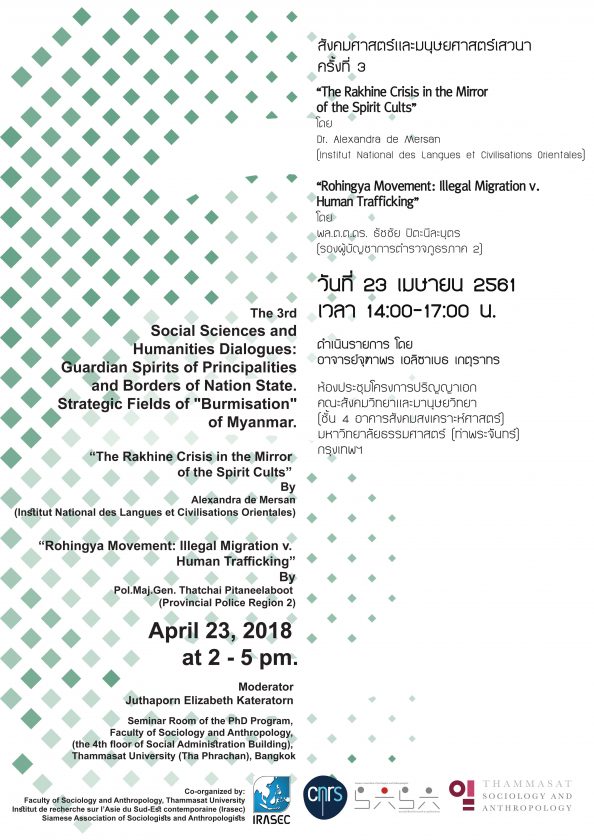
Faculty of Sociology and Anthropology in collaboration with Institut de recherche sur l’Asie du Sud-Est contemporaine (Irasec) and Siamese Association of Sociologists and Anthropologists (SASA) would like to invite audience to join a seminar of

The 3rd Social Sciences and Humanities Dialogues
Guardian Spirits of Principalities and Borders of Nation State,
Strategic Fields of “Burmisation” of Myanmar

Monday, 23 April 2018 | 2-5pm
PhD meeting room, Faculty of Sociology and Anthropology,
4th floor, Faculty of Social Administration Building,
Thammasat University, Tha Prachan
Programme

1.30 pm | registration

2.00 – 3.30 pm
The Rakhine Crisis in the Mirror of the Spirit Cults
Dr. Alexandra de Mersan
Institut National des Langues et Civilisations Orientales

3.30 – 5.00 pm
Rohingya Movement: Illegal Migration v. Human Trafficking
Pol.Maj.Gen. Tatchai Pitaneelabutr,
Deputy Commissioner of Provincial Police Region 2

Hosted by Arjan. Juthaporn Elizabeth Kateratorn

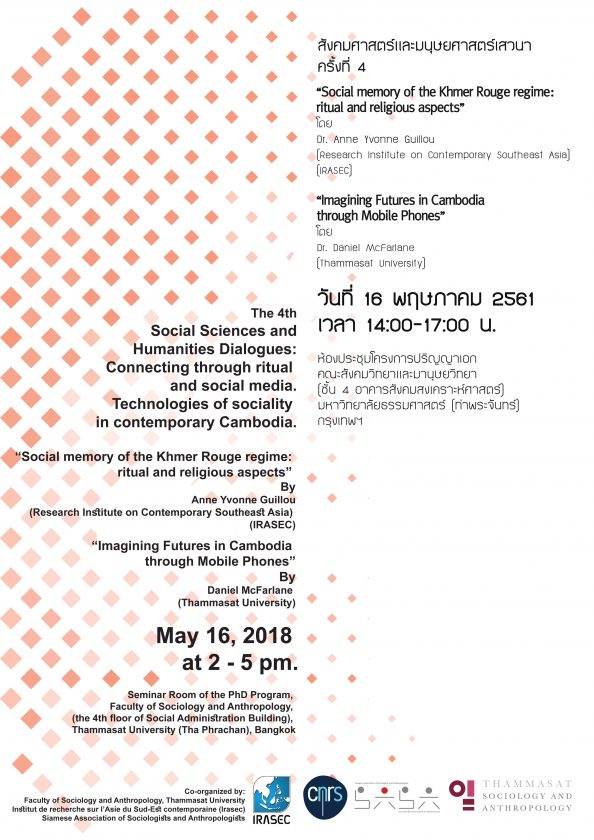
The 4th Social Sciences and Humanities Dialogues

Source: http://socanth.tu.ac.th/news/academic-events-updates/https-socanth-tu-ac-th-news-academic-events-updates-social-sciences-and-humanities-dialogues-4/

Faculty of Sociology and Anthropology in collaboration with Institut de recherche sur l’Asie du Sud-Est contemporaine (Irasec) and Siamese Association of Sociologists and Anthropologists (SASA) would like to invite audience to join a seminar of

The 4th Social Sciences and Humanities Dialogues:
Connecting through ritual and social media.
Technologies of sociality in contemporary Cambodia.

Wednesday, 16 May 2018 | 2-5 pm.
PhD meeting room, Faculty of Sociology and Anthropology,
4th floor, Faculty of Social Administration Building,
Thammasat University, Tha Prachan

Programme

1.30 pm | registration

2.00 – 5.00 pm
“Social Memory of the Khmer Rouge Regime: Ritual and Religious Aspects”

Anne Yvonne Guillou
(Research Institute on Contemporary Southeast Asia) (IRASEC)

Abstract

Social memory has been studied for decades by social scientists and can be broadly defined as social constructions of past events collectively experienced and remembered (or alternatively forgotten) by social groups. It has been analyzed primarily by anthropologists in reference to local perceptions of time and space (M. Bloch, A. Gell, A. Iteanu). Other researches in sociology, anthropology and political science have studied its social background (M. Halbwachs, Maurice Bloch, M. Auge), its cognitive dimensions (J. Candau), the political and social stakes of official commemorations (P. Nora, P. Connerton, J. Gillis), the embodiement of past events (D. Fassin) and the transmission of painful memory (D. Graeber, P.Antze et M. Lambek). Using this theoretical literature, Anne Guillou’s research on social memory of the Khmer Rouge regime in Cambodia is also based on ten years of ethnographic field work mainly in Western Cambodia. She has forged a specific methodology over time in order to better understand how the Khmer villagers collectively remember the times of the genocidal regime and copy with losses and painful remembrance. She comes to the conclusion that this memory is anchored in the Khmer religious system in which cults linked to the earth and the dead are crucial components.

And “Imagining Futures in Cambodia through Mobile Phones”
Daniel McFarlane (Thammasat University)

McFarlane’s talk will reflect on how futures are imagined, calculated and enacted through communication technologies and corporate marketing in Cambodia. His talk draws on ethnographic research he conducted in a period of rapid change in Cambodia. Mobile phone subscription rates were growing at nearly 50% per year, and nine mobile phone network operators dominated an emerging consumer market. At the forefront of the change were transnational corporations and Cambodian youth. McFarlane explores how the marketers of mobile network services in Cambodia constructed the youth as consumers and how young Cambodians turned mobile phones and networks into an infrastructure for imagining and exploring the future. From this vantage point, he constructs a critique of the representation of new mobile technologies as a reconciliation between neoliberal capitalism and the global poor by detailing the collisions and disjunctures between the imaginings of corporate marketers and Cambodian youth.

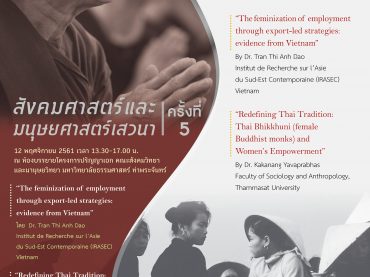
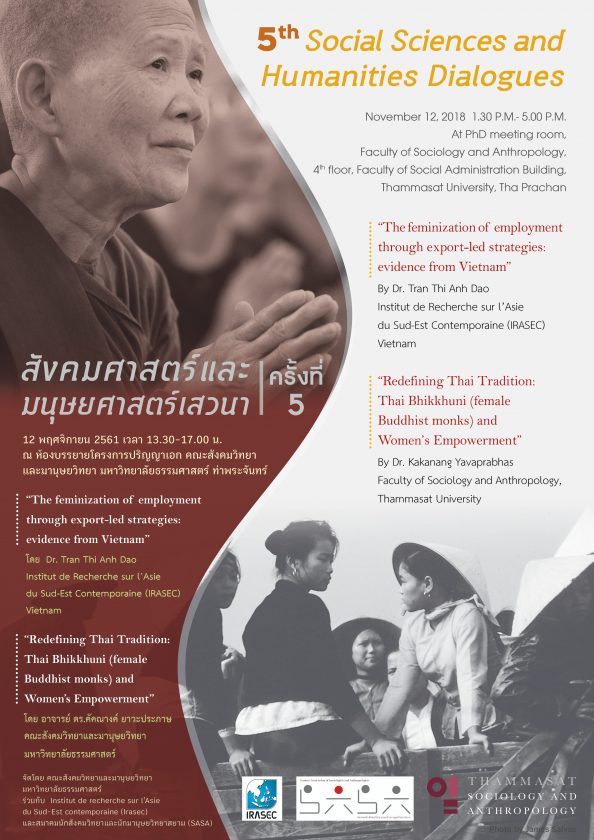
The 5th Social Sciences and Humanities Dialogues

Source: http://socanth.tu.ac.th/news/academic-events-updates/social-sciences-and-humanities-dialogues-5th/

Faculty of Sociology and Anthropology in collaboration with Institut de recherche sur l’Asie du Sud-Est contemporaine (Irasec) and Siamese Association of Sociologists and Anthropologists (SASA) would like to invite audience to join a seminar of the 5th Social Sciences and Humanities Dialogues.

Monday, 12 November 2018 | 1.30 – 5 pm.
PhD meeting room, Faculty of Sociology and Anthropology,
4th floor, Faculty of Social Administration Building,
Thammasat University, Tha Prachan

Programme

1.30 pm| registration

2.00 – 3.30 pm
“The Feminization of Employment through Export-led Strategies: Evidence from Vietnam”

Dr. Tran Thi Anh Dao
Institut de Recherche sur l’Asie du Sud-Est Contemporaine (IRASEC) Vietnam

Abstract

The early successful experiences of the East Asian NICs confirmed the role of exports as an engine of growth. Surprisingly, most of the earlier studies omit one important empirical fact, namely that the feminization of work contributed significantly to their rapid industrialization. Feminist trade theories argue that export-oriented development strategies have so far been exploitative of cheap female labour in the South. As globalization gathers pace, an increasing number of women in Developing Countries (DCs) have been absorbed into labour-intensive, export-oriented manufacturing sectors. However, the the structural changes that go hand in hand with export promotion, as well as the international environment the South faces today, have dramatically modified the processes whereby macroeconomic shocks are transmitted. The question is whether export-led growth, which tends to be “female-intensive” in the early stages, has increased the vulnerability of DCs that have become embedded in complex subcontracting networks. By examining women’s labour force participation rate in Vietnam, we show how patterns of gender relations stemming from structural characteristics, as well as social and institutional practices, impact on the macroeconomic outcomes of an export- oriented strategy.

3.30 – 5.00 pm
“Redefining Thai Tradition: Thai Bhikkhuni (female Buddhist monks) and Women’s Empowerment”
Dr. Kakanang Yavaprabhas
Faculty of Sociology and Anthropology, Thammasat University

Abstract

Traditionally in Thai society, where Theravada Buddhism is prevalent, only men can be fully ordained as bhikkhu (monks). Only in 2003 that the first Thai woman has controversially become ordained as a ‘Theravada’ bhikkhuni (fully ordained nun, female Buddhist monk). Currently, there are at least 270 bhikkhuni and novices across the country. Based on an ethnographic fieldwork, this presentation looks at these Buddhist women and their impact on society. It proposes that while the bhikkhuni may not uphold a feminist agenda, they empower laywomen, particularly through offering them the new temporary ordination.
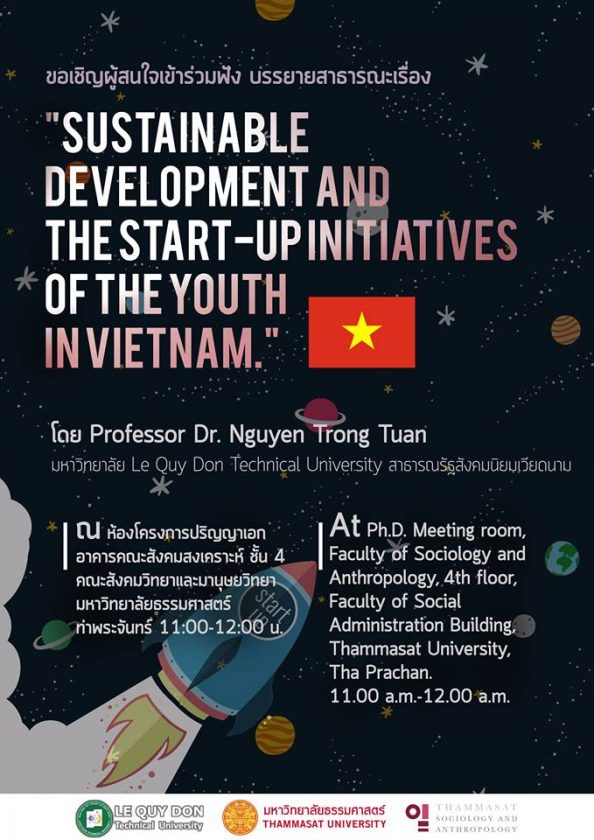
“Sustainable Development and the Start-up Initiatives of the Youth in Vietnam.”

Source: http://socanth.tu.ac.th/news/academic-events-updates/sustainable-development-the-youth-in-vietnam/

Research and Academic Service Section, Faculty of Sociology and Anthropology, Thammasat University, would like to invite audience for public lecture on “Sustainable Development and the Start-up Initiatives of the Youth in Vietnam” by Professor Dr. Nguyen Trong Tuan, Le Quy Don Technical University, the Socialist Republic of Vietnam.

Monday 12 November 2018
9.30 am – 1.30 pm at Doctorate Program Meeting Room, the Building of Social Administration Faculty, 4th Floor, the Faculty of Sociology and Anthropology, Thammasat University, Tha Prachan Campus

Interested audience can register in front of the seminar.

Atmosphere of the 10th Sociology and Anthropology Bond

Source: http://socanth.tu.ac.th/news/super-soc-2018/

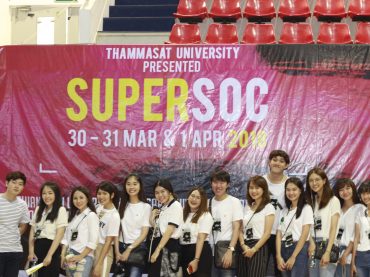
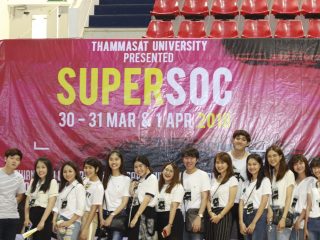
The Faculty of Sociology and Anthropology, Thammasat University, hosted the 10th Sociology and Anthropology Bond (SuperSoc 2018) from 30 March – 1 April 2018 at Thammasat University, Rangsit Campus.
Students in the fields of Sociology and Anthropology from seven universities represented their institutions, which were:

  • Thammasat University
  • Kasetsart University
  • Chiang Mai University
  • Srinakharinwirot University
  • Prince of Songkla University
  • Silpakorn University
  • Khon Kaen University

This event is held annually and for the 10th year, the Faculty of Sociology and Anthropology of Thammasat University hosted this bonding event.

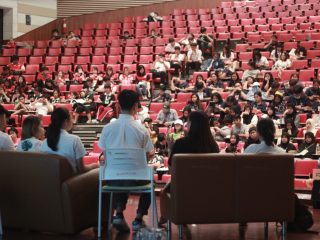
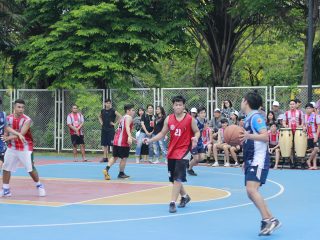
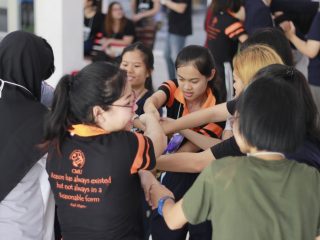
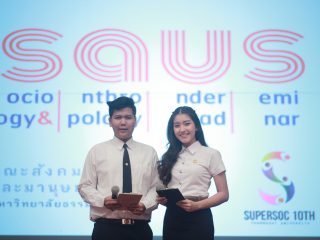
The Annual 10th Sociology and Anthropology Bond consisted of many activities such as group-bonding events, volunteer activities, cheering & cheerleading performances, sports competitions (volleyball, chair ball, basketball, football, fun sports and eSports), Super SOC Night Party and the 2nd SAUS – Sociology and Anthropology Undergrad Seminar.

Photographs by Photography Unit of the Annual 10th Sociology and Anthropology Bond